


Brian's Olympic Blog
- talkthatsportza
- Oct 1, 2021
- 4 min read
South African star and his mental struggles
Rio Olympics 2016, South African runner Wayde Van Niekerk put his name on the map by breaking a 17-year-old record, shattering Micheal Johnson's record with a world-record time of 43.03s. He also became the first person to win an Olympic 400m race and break a world record from lane eight, which traditionally puts runners at a disadvantage due to the staggered start. And to cap his year off, he won the best male athlete award at the Rio Olympics 2016.
Fast forward 5 years (one year extra due to COVID) Tokyo 2020 has anything but smooth sailing for Wayde. During a celebrity charity rugby match in October 2017, Wayde made an inverted cut and tore his anterior cruciate ligament (ACL) which required immediate surgery. He was only able to make a return to running in the IAAF Diamond League meet in London two years later.
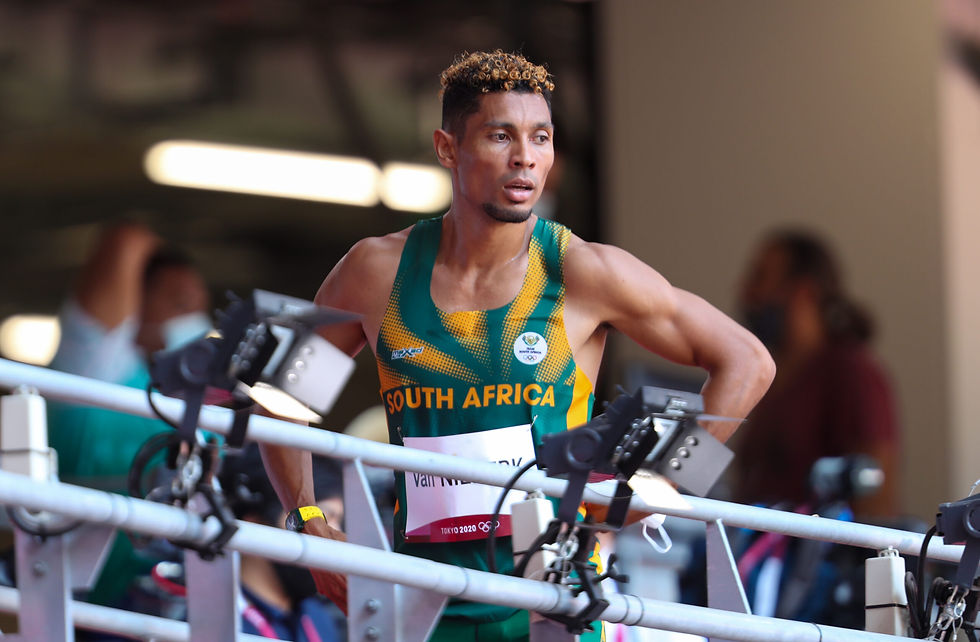
However, the world record holder had much to rue during his 2020 Olympic run, running in lane eight again, he had to play catch-up in the third semi-final race, started slowly with a reaction time of 0.381. This left too much work to do for the gold medalist and he bowed out in the semi-final, leaving him bitterly disappointed and unable to defend his title.
The final however ended up as a great race with Bahama's Steven Gardiner winning the race in a time of 44.14 and American Michael Norman finished second in 44.52.
In the immediate aftermath of the race, he told Team SA media “Very disappointed with the run. I expected way more from myself, but it didn't work out the way I wanted it to work out, It is what it is and we move forward”
Talking to South Africa’s biggest sports publication News 24, he spoke about the mental challenges he face leading up to the Olympics and how it affected him and his training.
“Looking back at this year, in so many ways it’s really been crazy and generally tough. Not only did the COVID-19 pandemic create inconsistencies with socializing and interaction, but it also affected our fitness,” he said.

But looking forward, he is optimistic about what is to come, during an interview with Soweto publication he said “I believe the upcoming season and year will definitely be the perfect opportunity for me to polish up on what I messed this year. I don’t think I am that far off from where I need to be and it is not much of a worry for me”
Despite his obvious disappointment with the event as a whole, I believe Wayde deserves plaudits from the country as a whole. To fight your way back from a severe injury such as is an ACL injury and still qualify and compete with the best athletes in the world is no small feat.
Wayde, you’re still a national hero
Like a Pheonix, Anaso rises from the ashes.
Anaso Jobodwana, as someone I’ve known since I was 6, I couldn’t be more proud of his ascent. I first set my eyes on him when I went to Dale College in King Williams Town, and followed him to eQonce at Selborne College, where you could spot the raw ability from a young age.
Being in a boarding school with him, watching how he shape his mentality, watching how dedicated he was when training, eating and sleeping. It was only his destiny for him to be running next to arguably the greatest athlete of all time, Usain Bolt.

Jackson State University in Mississippi, USA is where Jobodwana made his name as an athlete. He broke multiple records which earned him all American colours in his first year in America. He then proceeded to qualify for the London Olympics in 2012. Jobodwana won the 100m and 200m race combo at the University Games in Russia in 2013, and the went to truly burst on the international scene in 2015 Beijing World Athletics Championships, where he ran his current personal best time of 19.87s behind Bolt and American Justin Gatlin.
However, his journey to 2020 Tokyo Olympics had more than a few bumps in the road. He struggle with his running leading up to the Tokyo Games and could not run a qualifying time prior to the event. In fortunate circumstances, Jobodwana still made the South African side for the 200m sprints due to his international ranking.
Despite the initial setback, he made a promising start to the 2020 Olympics finishing third in his heat, which allowed him to qualify for the semifinal. Sadly, running in the first semi-final, Jobodwana couldn't perform well enough and finished last in a time of 20.88. And that is where the road ended for the 29-year-old as he failed to progress to the 200m final.
Speaking to News 24, the South African star said “It’s just learning, it's been a while that I've been back at this level. There's a lot to learn, you can never stop learning so just happy to be here so I can know what to do for next season. No complaints"

He also delved into how his body is ageing and with that, the fundamental ability to run as fast as he could is just not there any longer but is still happy that he was able to once again compete with the world best.
“Time-wise, it isn't really good as I've ran faster (back then). I wasn't happy with my times this year and my battery was low, I wasn't able to hit the ground properly... Not to make excuses, my season was topsy turvy, my body wasn't in a really good space," he said.
"I'm happy to make the semi-final and it tells me that even with a bad season, I can still do well and keep on building from this
Despite the disappointment for Anaso, he can still be proud of his efforts and career as a South African athlete.
While we’re on the subject of great athletes, we at Talk That Sport would also like to applaud Ntando Mahlangu, who picked up two gold medals in Japan, breaking the world record in the long jump T63 and winning the men's 200m T61.

As well as Anrune Weyers who won in the women's 400m T47, and Para-cyclist Pieter du Preez who won the men's H1 time trial.

Comments